
How to use this checklist
Outdoor events vary enormously: a garden party for 50, a marquee wedding on farmland, a company fun day on a business park, a village fete on the green. The details differ, but the questions don't. Work through each section, note anything you're unsure of, and share it with your caterer early.
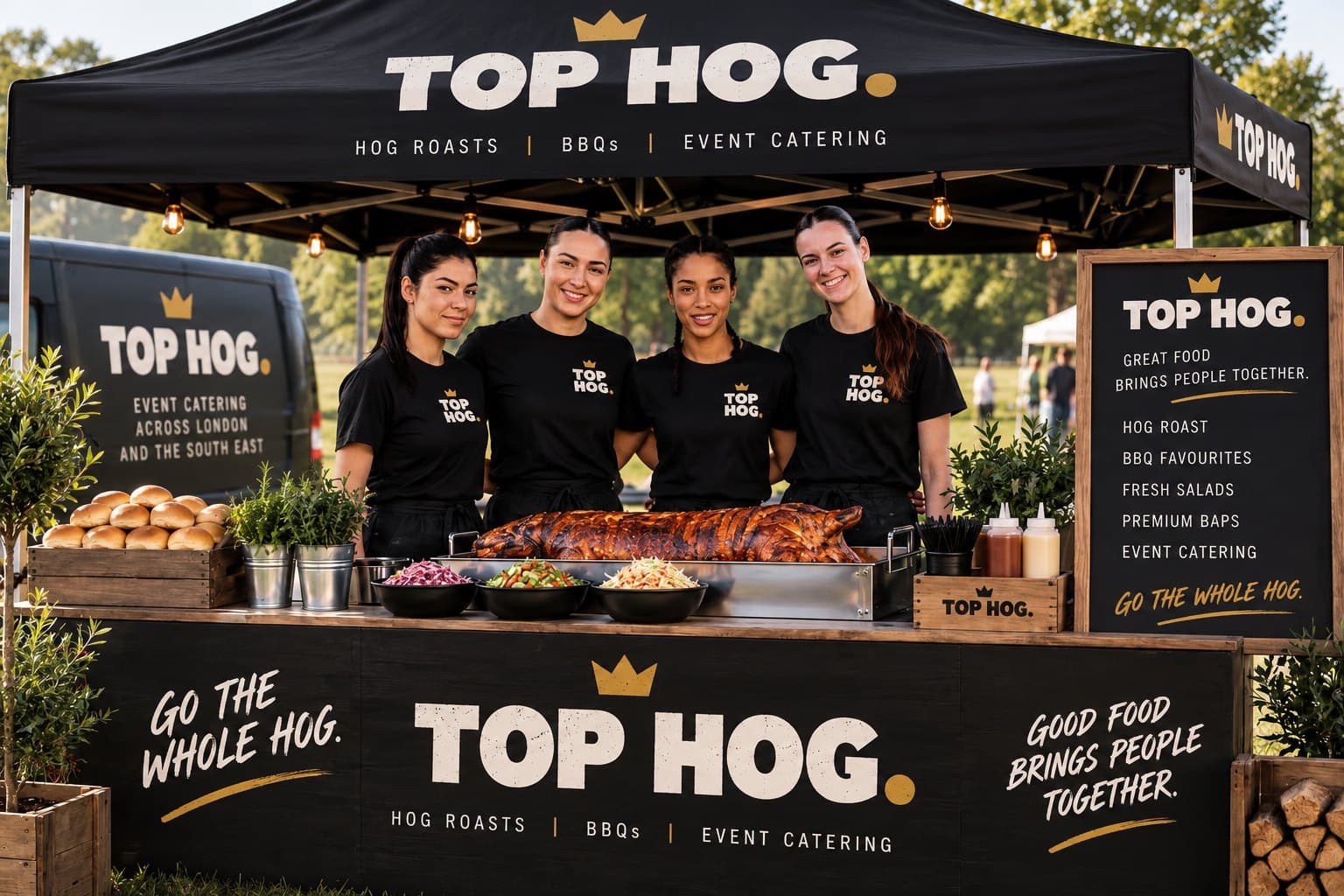
Some of this is the caterer's job and some is yours. As a rule, a full-service caterer like us looks after the cooking area, the food, the serving and clearing away our own equipment and waste. The host looks after the site, the guests' comfort and anything the venue or landowner requires. Our outdoor event catering page explains what we bring.
The same principles apply at every scale. A garden party at home might only need a few of these points ticked off, while a marquee wedding on private land will need nearly all of them. Either way, it's far easier to sort them a few weeks out than on the morning.
Access and arrival
- Vehicle route: can a van reach the cooking area, or close to it? Note width restrictions, low branches, bollards and height barriers.
- Gates and codes: who has the keys or codes, and will someone be there at arrival time?
- Distance to carry: how far from where the van stops to where we'll cook? Steps, slopes and gravel all matter.
- Arrival time: a hog roast needs several hours of cooking, so the team arrives long before guests. Check that works for the site.
- Directions: rural sites and large estates often need more than a postcode. A what3words reference or pinned location helps.
The cooking area
- Ground: firm and as level as possible. Soft lawns after rain can be a problem for heavy equipment.
- Space: room for the cooking equipment, a serving counter, prep space and a queue, with safe clearance around the cooking area.
- Position: away from marquee walls, overhanging trees, doorways and building air vents; downwind of the main guest area if possible.
- Power: is there a socket within reach, or should the caterer be self-sufficient? Tell us either way.
- Water: access to a tap is helpful. Tell us if there isn't one so we bring what we need.
- Shelter for the cooking area: we bring cover for our own setup; tell us if the venue has rules on gazebos or pegging into the ground.
- Lighting: for evening service, the serving area needs to be well lit. Festoon lights look lovely but may not be enough on their own.
Guest comfort (the host's side)
These aren't usually part of a catering booking, but they make or break an outdoor event.
- Toilets and handwashing for guests: on-site facilities, or hired units for larger events.
- Seating and tables: especially important if food is plated rather than hand-held.
- Shelter for guests: marquee, gazebos or an indoor fallback for rain or strong sun.
- Drinking water and soft drinks, particularly on hot days.
- Bins: plenty of them, clearly placed. We take our own waste; guest waste from drinks and elsewhere needs a plan.
- Parking for guests, plus a clear space kept for the catering vehicle.
- Lighting on paths and around toilets after dark.
- First aid: someone who knows where the kit is.
Timings
Work backwards from when you want to eat. Tell your caterer the time food should be ready to serve, not just when the event starts; the two can be hours apart. For a hog roast, cooking starts well in advance, so the team will be on site early in the day.
Agree how long service lasts, whether there's a second serve later (say, evening food after an afternoon BBQ), and when the site needs to be cleared. If the venue has a hard finish time, share it.
Build in slack. Outdoor events tend to run late, not early, and food that's ready and waiting holds far better than guests who are hungry and waiting.
The weather plan
Decide your plan B before you need it. The key question isn't whether the food can be cooked in the rain (it can; the cooking area has cover), but where guests will eat and queue. A marquee, a barn, a garage, a village hall or a house with the doors open can all work.
Agree a trigger point, such as a forecast check two days out, and who makes the call. If you're hiring a marquee or gazebos as a contingency, check their cancellation terms.
Hot weather needs planning too: shade for guests, cold water, and serving times that avoid the hottest part of the day. Salads and cold sides are best kept out of direct sun, which is something we'll manage on our side.

Neighbours and permissions
- Landowner or venue approval for outdoor cooking, including where equipment can go.
- Business park or managing agent sign-off for workplace events. See our corporate BBQ planning guide.
- Public spaces: events on commons, parks or village greens usually need permission from the council or parish, and may have conditions.
- Neighbours: a friendly note about smells, music and finish times goes a long way at home events.
- Licences: selling alcohol or holding a large public event may need a licence from the local authority. Check early.
- Documents: venues often ask caterers for public liability insurance and food hygiene details. Any established caterer should provide them readily.
Outdoor catering questions
Do you need mains power?
Not necessarily. Tell us what's available on site and we'll plan around it. It's one of the questions on our quote form.
Can you set up on grass?
Usually, yes, provided it's reasonably firm and level. After heavy rain, some lawns become too soft for heavy equipment, so we'll discuss alternatives if needed.
Who provides tables and chairs for guests?
Normally the host or venue. We bring what we need for cooking and serving. Tell us if you need advice on quantities for plated service.
What happens to leftover food?
Discuss this with your caterer beforehand. Food safety rules affect what can be left behind once it's been out for service.
Can you cater at a festival or public event?
Yes. Fetes, fun days and community events are part of our outdoor event catering. The organiser usually handles overall event permissions.